
India is one of the largest consumers of edible oils in the world. Despite having a strong agricultural base, the country continues to depend heavily on imports to meet its vegetable oil demand. This growing import dependence has raised serious concerns for the economy, food security, and the livelihoods of millions of Indian farmers. To address this issue, the Government of India launched the National Mission on Edible Oils – Oilseeds (NMEO-Oilseeds), aiming to boost domestic production, reduce imports, and make India self-reliant in edible oil.
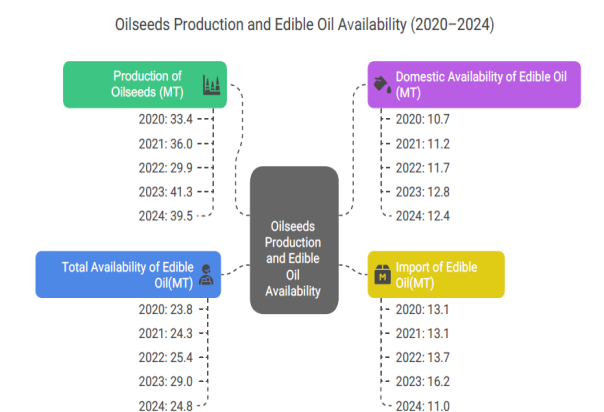
        Over the past decade, India’s edible oil imports have more than doubled—from 7.9 million tonnes (mt) in 2013–14 to 16.4 mt in 2024–25. In value terms, imports rose sharply from ₹572 billion to $20.8 billion. A key factor behind this rise was the Russia-Ukraine war, which disrupted global supply and drove up prices. Even after prices eased, import volumes remained high, reflecting India’s deep dependence on foreign edible oils. In 2024–25, India mainly imported 7.5 mt of palm oil (from Indonesia and Malaysia), 4.8 mt of soybean oil (from Argentina and Brazil), and 3.5 mt of sunflower oil (from Russia, Ukraine, and Argentina). In contrast, domestic oil production from oilseeds and secondary sources like cottonseed, rice bran, and maize stood at only around 10 mt—meeting less than 40 percent of national demand. This high import dependence strains foreign exchange, exposes the country to global price shocks, and undermines income stability for Indian oilseed farmers.
         To curb food inflation, the Indian government on May 30, 2025, reduced the basic customs duty on crude palm, soybean, and sunflower oil from 20% to 10%, bringing total import tax down from 27.5% to 16.5%. This came as CPI inflation for vegetable oils hit 17.9% in May. While the move eased consumer prices, it raised concerns among domestic producers. The U.S. Department of Agriculture (USDA) predicted a rise in soybean oil imports, including from the U.S. The Soybean Processors Association of India warned that cheaper imports could flood the market, reduce profitability for local farmers, and lead them to shift away from oilseed cultivation in the upcoming kharif season.
           To tackle rising import dependence, the government launched NMEO-Oilseeds as a comprehensive mission covering the entire oilseed value chain—from high-quality seed development and climate-resilient farming to processing, value addition, and market linkage. It builds on earlier efforts like NFSM-OS&OP (2018–19), PM-AASHA, and the Yellow Revolution of the 1980s, but goes further by focusing on technology, scale, and integrated solutions. The mission promotes climate-resilient cropping, certified seed use, and decentralized oil processing. It integrates digital tools like the SATHI portal for better planning and forecasting, helping reduce input delays and improve productivity. Strengthening Farmer Producer Organizations (FPOs) is another key element. By linking FPOs with seed agencies, research bodies, and processors—and supporting them with training, finance, and digital access—the mission aims to build a stable, profitable oilseed ecosystem and boost farmer incomes.
      Despite these efforts, several challenges persist. India’s oilseed yields remain low compared to global standards due to small, fragmented landholdings, poor mechanization, limited access to quality inputs, and frequent pest attacks. A major hurdle is that much of oilseed farming is rainfed, making it heavily reliant on the monsoon and risky for farmers, especially in dry regions. Integrating NMEO-Oilseeds with schemes like Pradhan Mantri Krishi Sinchayee Yojana (PMKSY), which promotes micro-irrigation and efficient water use, is crucial. Improved irrigation can help stabilize yields and reduce farmers’ vulnerability.
          For NMEO-Oilseeds to truly achieve its goals, a stable and supportive policy environment is vital. Sudden changes in import duties and price policies create uncertainty and reduce farmer motivation to invest in oilseed cultivation. Striking the right balance between consumer affordability and farmer profitability is key. While duty cuts may offer short-term relief from inflation, they can weaken long-term confidence in the sector. India’s edible oil ecosystem needs a clear, long-term strategy—one that goes beyond production to include infrastructure, credit access, training, irrigation, and market reforms. NMEO-Oilseeds offers a strong foundation to move toward self-reliance, improve farmer livelihoods, and reduce dependency on imports. With sustained commitment and coordinated action, India can transform its oilseed sector into a secure and self-sufficient pillar of national food and economic security.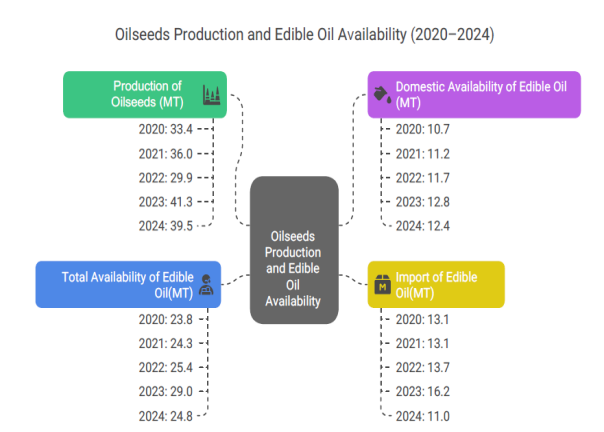
References:
1.Ministry of Finance, Government of India. (2025). Union Budget 2025-26: Budget Speech, Expenditure Budget and Key Highlights.
2.Ministry of Finance, Government of India. (2024). Economic Survey 2024-25.
3.Department of Food & Public Distribution (DFPD). (2024).
4.Import & Export. Ministry of Consumer Affairs, Food & Public Distribution, Government of India.
5.Press Information Bureau. (2024a, July 30). Production and import of pulses. Government of India.
6.Press Information Bureau. (2024b, October 3). Cabinet approves National Mission on Edible Oils – Oilseeds (NMEO-Oilseeds) for 2024-25 to 2030-31. Government of India.
Written by
Komal Phalke, Research Officer (Agriculture & Water)
PARC, Pune